

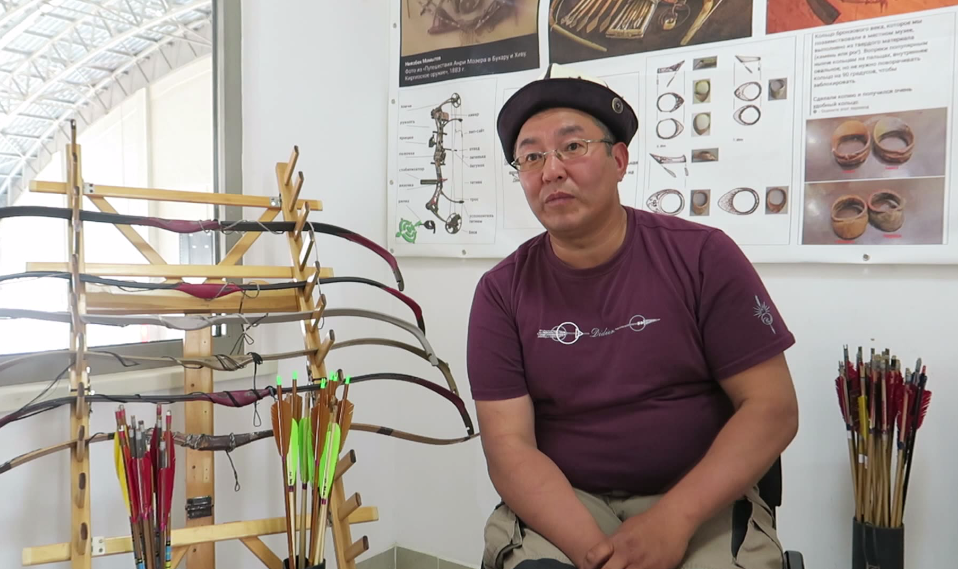
Master bow-maker Samat Suyorkulov has spent the last 15 years committed to the preservation of traditional bow and arrow crafting in Kyrgyzstan. At 50 years of age, he has reignited a childhood interest and currently imparts his knowledge of traditional archery at Kyrgyzstan-Turkey Manas University. After an extensive study of ancient Turkic and Kyrgyz bow designs, Suyorkulov now forges these historic weapons by combining traditional techniques with modern advancements. Notably, despite earning a degree in Theology from Osh State University, he devoted much of his career to working as a chef.
A Childhood Curiosity
Suyorkulov’s love for archery began in his youth. “I used to ask my grandmother how bows were made,” he reminisces. “Her knowledge was limited, so she would say they were crafted from willow branches, which led me to try making them myself. Out of all my friends, my bows consistently shot the furthest and performed the best. I even experimented with arrowheads made from bones, nails, and any materials I could scavenge.”
As he matured, his life took various turns. “I was busy with family obligations, pursuing my studies in theology, and eventually marrying. For a significant time, I couldn’t focus on bow-making,” he shares. “Despite completing my theology degree, I never worked in that field. My passion for cooking, which began in childhood, ultimately led me to a career as a chef.”
The Search for Lost History
At the age of 33, Suyorkulov reconnected with his true passion. He enrolled in sport archery courses but swiftly realized that modern equipment did not appeal to him. His goal was to rediscover the traditional bow-making methods of his ancestors.
“I wanted to learn precisely how they crafted bows. I consulted the elders, but I struggled to gather sufficient information,” he reflects. “I conducted online research and visited museums, but regrettably, I couldn’t find a single fully preserved traditional bow on display.”
He notes that bone fragments and arrow remnants occasionally found during archaeological excavations are predominantly attributed to ancient Hun bows. “These weapons were made from organic materials like horn, wood, and horse tendon, which deteriorated over time. Only the bone fragments have endured,” he elaborates. “As far as I know, the Kyrgyz utilized Hun-style bows until the 10th century, after which the design evolved.”
In his research, Suyorkulov also discovered that Manchu bows, historically used by ancient Chinese and Buryat cultures, were kept in museum storage facilities. This led him to conclude that the Kyrgyz likely employed bows strikingly similar to these throughout the 13th and 14th centuries.
Trial, Error, and Mastery
Equipped with historical insights, Suyorkulov crafted his first authentic bow around 2014 or 2015. “For that initial attempt, I used pine wood, horn, and horse tendon. However, cracks soon developed, revealing that pine was not the ideal choice,” he confesses. “I later restored that bow and donated it to the National Museum, where it remains on display.”
Undeterred by this setback, Suyorkulov delved deeper into traditional techniques, even studying Korean and Chinese methods. “Korean bows are made from bamboo, while Chinese manufacturing methods closely resemble those of our ancestors,” he notes.
He emphasizes the pronounced difference between ancient craftsmanship and contemporary production. While historical bows were made entirely from horn, tendon, and wood, modern replicas often incorporate fiberglass and advanced adhesives. “Traditional-style bows made with modern materials are much more resilient to water and freezing conditions,” he points out. “The authentic older bows were highly susceptible to moisture and demanded constant maintenance.”
“While People Were Buying Houses…”
For many years, Suyorkulov balanced his demanding role as a chef with his commitment to bow-making, dedicating all his free time to the craft. This was no easy feat.
“While others were busy purchasing houses and cars, I was investing everything into my bow research,” he recalls. “Initially, my wife and family found it hard to understand my passion. But I persevered. Looking back, I have no regrets. I genuinely believe I’ve played a role in reviving an art form that was on the brink of disappearing.”
He strongly believes that the Kyrgyz people have become disconnected from their martial history. “Our museums hardly showcase any shields, bows, or swords today. Most of those artifacts were taken abroad long ago,” he laments.
By 2016, his expertise had grown significantly, and his creations began to closely resemble genuine historical artifacts. Currently, his collection features Hun, Korean, Turkish, and Manchu-style bows.
A trip to Kahramanmaraş, Turkey, that same year opened his eyes to the true market value of his work. “I witnessed handmade bows selling for over $5,000. I sold one of mine for $1,400 and another for $500,” he states.
Such high valuations underscore the immense patience required for the craft. “With materials at hand, one can create a traditional English longbow in a few hours. However, employing our ancestors’ methods can take anywhere from six months to a full year,” he explains. “Once the horn and tendon are attached to the wood, the bow must sit and cure for an extended period.”
To date, Suyorkulov has crafted 14 complete traditional bows. Two of these broke during the delicate curing process, and he has generously gifted most of the others.
Passing the Torch to a New Generation
Traditionally, archery was perceived as a mere pastime in Kyrgyzstan. However, in recent years, interest in traditional archery has surged—a cultural shift that Suyorkulov has directly contributed to.
Four years ago, he proposed a program to Kyrgyzstan-Turkey Manas University to establish formal traditional archery training. The university welcomed the initiative, launching the first traditional archery courses in the nation.
“Every day, interest grows, and there is a palpable national awareness blossoming among the people,” he states with pride. “It is our responsibility to pass this ancestral heritage on to future generations. Understanding our history is crucial. We dedicate our time to this work because if we don’t take the initiative, no one else will. It’s a matter of patriotism.”
In addition to cultural preservation, Suyorkulov highlights the significant personal benefits of the sport for the youth. “Archery teaches children how to set clear goals. Kids who begin early tend to grow into calmer, more balanced, and disciplined individuals,” he notes. “Physically, it’s an incredibly advantageous sport.”
Presently, his classes at Manas University are filled to capacity, with a notably high number of female students. Thanks to these grassroots efforts, Kyrgyz archers are starting to gain recognition in international competitions.
Suyorkulov smiles as he observes the broad appeal of archery: “We have individuals ranging from five-year-old children to 70-year-old adults who are utterly captivated by the sport.”


